
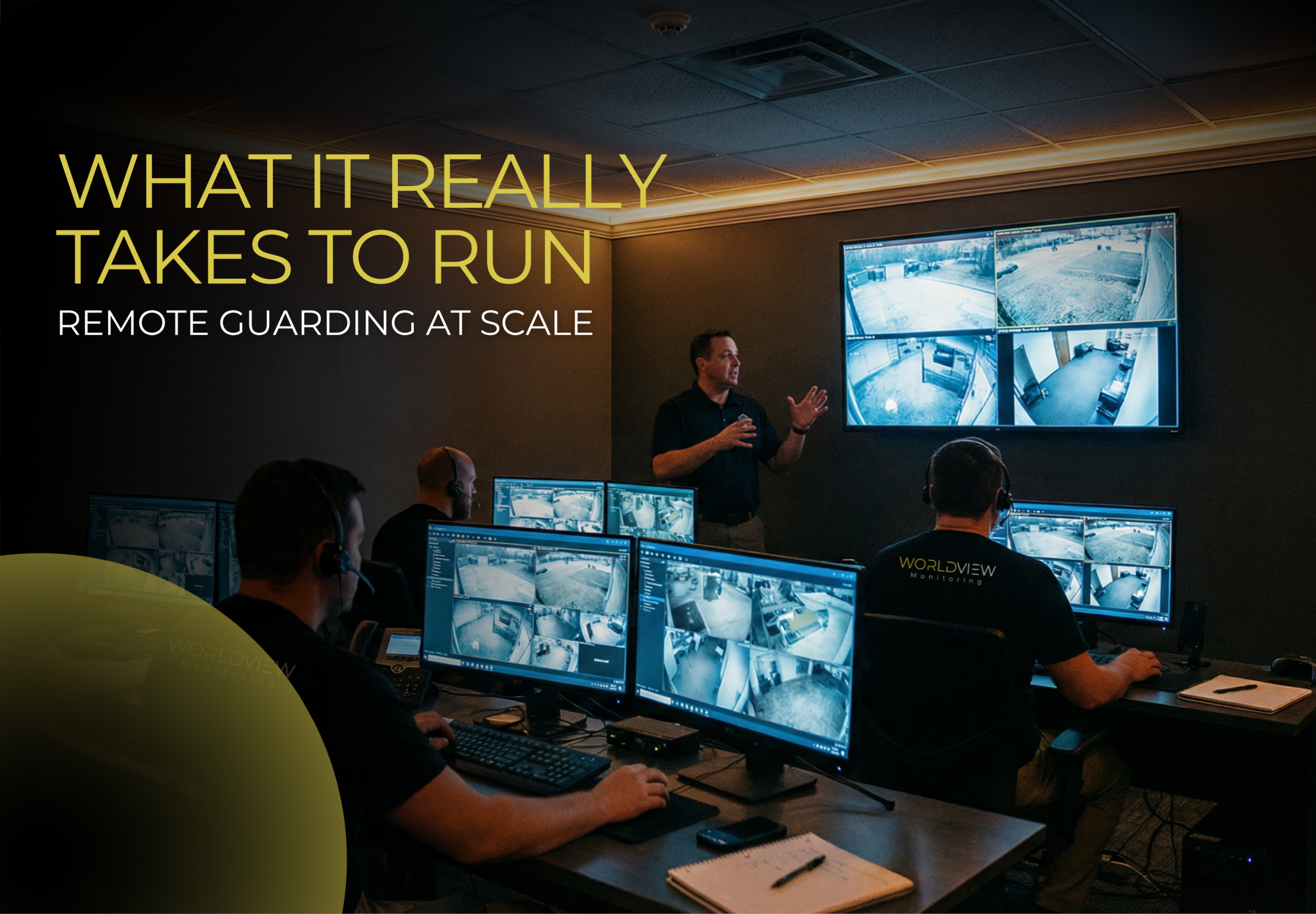
The Operational Reality Monitoring Centers Don’t Talk About
Most monitoring centers first approach remote guarding as a technology decision. Cameras, analytics, and platforms tend to dominate internal conversations because they are tangible, comparable, and easy to evaluate on paper. Those components matter, but they rarely determine whether a remote guarding program performs reliably once it begins operating at scale.
The real complexity lives inside the operation itself. Staffing discipline, training consistency, escalation control, and the ability to maintain performance under changing conditions ultimately shape outcomes. These challenges become more visible as volume increases and incidents stop behaving neatly or predictably.
Remote guarding can look straightforward when it is limited in scope. It becomes far more demanding when it must operate night after night, across hundreds or thousands of cameras, without introducing operational strain or exposing the monitoring center’s brand to unnecessary risk.
At Worldview Monitoring, this is the work we do every day. We operate remote guarding exclusively for wholesale monitoring centers, which gives us a clear view into what separates programs that hold up over time from those that quietly struggle once scale is introduced.
Selling Remote Guarding Is Easy. Running It Well Is Not.
Dealer demand for remote guarding already exists. End users expect proactive response, and many dealers now view video monitoring as a baseline capability rather than a premium add-on. From a sales perspective, the value proposition is relatively easy to communicate.
The operational weight shows up after the service goes live.
Video monitoring introduces a different rhythm than traditional alarm monitoring. Events are more frequent and often ambiguous, requiring operators to balance patience with decisiveness. Long stretches of routine activity are interrupted by moments that demand accurate judgment under pressure. At a small scale, these demands can be absorbed informally. As volume increases, they begin to test the structure of the operation itself.
This is often the point where remote guarding programs reveal weaknesses that were not apparent during early rollout.
Staffing Is About Sustainability, Not Headcount
Remote guarding requires sustained focus, not just coverage. Operators are expected to process repetitive events accurately while maintaining sound judgment during exceptions. Staffing for that environment involves far more than filling shifts on a schedule.
Monitoring centers frequently underestimate how difficult it is to maintain consistency over time, particularly during overnight hours. Fatigue, turnover, and uneven experience levels introduce risk that compounds quietly. The difference between a nuisance event and a legitimate incident is rarely obvious, and judgment improves only through exposure to real-world conditions.
Without a structure that supports operators, reinforces standards, and accounts for the mental demands of the work, staffing becomes an ongoing variable rather than a stable foundation.
Training Drift Happens Quietly
Most remote guarding programs begin with clear SOPs and structured onboarding. Early performance reflects that preparation, and confidence builds quickly.
Over time, drift sets in. New operators learn by observation rather than protocol. Small shortcuts work their way into daily routines. Escalation thresholds soften. Edge cases are handled inconsistently. None of this happens all at once, which makes it difficult to identify before performance begins to degrade.
Training drift is not the result of negligence. It is a predictable outcome when reinforcement and oversight do not scale alongside volume.
For wholesale monitoring centers evaluating whether to build remote guarding internally or rely on a partner, this is where the real decision lives.
Worldview Monitoring works exclusively with wholesale monitoring centers to deliver operationally disciplined remote guarding, allowing partners to expand video capabilities without adding internal staffing burden or operational fragility.
Escalation Is Where Brands Are Protected or Exposed
Most video events are routine. What defines a remote guarding operation is how it handles exceptions.
When an incident does not follow the script, escalation discipline determines whether the situation remains controlled or becomes a reputational issue. Clear authority, documented procedures, and timely oversight matter most during these moments, particularly overnight when decisions still carry weight.
Worldview’s operating model is built around this reality. Escalation paths are defined, senior oversight is accessible, and incidents are documented with the expectation that lessons feed directly back into training and process refinement.
Continuity Is Not Optional at Scale
Remote guarding does not tolerate downtime. Once volume increases, continuity planning shifts from being a safeguard to a requirement.
Staffing shortages, volume spikes, weather disruptions, or platform issues can overwhelm operations designed for average conditions. At scale, performance is defined less by ideal days and more by how consistently the operation holds up under stress, including the days when conditions are far from ideal.
Worldview addresses this through redundancy, overflow capacity, and deliberate scaling strategies designed to absorb variability without degrading response quality or decision-making discipline.
Build vs. Outsource Is an Executive Decision
For wholesale monitoring centers, the decision to build or outsource remote guarding is strategic. In-house programs require sustained leadership attention, capital investment, and tolerance for operational complexity. For some organizations, that approach aligns with long-term objectives.
For many others, remote guarding gradually becomes a distraction from core monitoring operations and dealer support. Outsourcing execution allows monitoring centers to retain ownership of the service while shifting day-to-day operational complexity elsewhere.
Worldview’s role is not to replace monitoring centers. It is to operate as an extension of their standards, processes, and expectations.
What Worldview Was Built to Do
Worldview Monitoring was built to run remote guarding operations at scale. Working exclusively through wholesale monitoring center partnerships, Worldview operates behind the scenes to deliver disciplined, protocol-driven execution without channel conflict or brand exposure.
Operators are trained for sustained performance, not short-term throughput. SOPs are enforced and refined continuously. Escalation is supported by experienced oversight. Capacity is scaled deliberately. Communication is structured to reinforce monitoring center brands rather than compete with them.
The Measure of Success
Remote guarding does not fail because of cameras or analytics. It fails when operations cannot keep pace.
Monitoring centers that succeed tend to focus less on feature sets and more on discipline. When remote guarding is executed well, dealers remain confident, escalations stay contained, and operational stress is minimized.
That is what it actually takes to run remote guarding at scale inside a monitoring center.
Operational discipline determines whether remote guarding strengthens or strains a monitoring center.
If your organization is being asked to offer video monitoring without compromising service quality, margins, or dealer trust, the conversation should begin with execution.
Worldview Monitoring partners exclusively with wholesale monitoring centers to deliver remote guarding that holds up under real operating conditions, consistently and without disruption.
Hi, this is a comment.
To get started with moderating, editing, and deleting comments, please visit the Comments screen in the dashboard.
Commenter avatars come from Gravatar.